
Annual Report – FY 2017-2018


President’s Message
I am very pleased to present the 2017-2018 annual report of the Friends of St. Marks Wildlife Refuge.
We can all be extremely proud of the Friends accomplishments made during this past year as you will read about in the following pages.
Highlights of this year’s accomplishments include:
- Restoration of the lighthouse Keeper’s Quarters
- Funding for interns for the Environmental Education program
- Continued funding for conservation interns
- New POS (point of sale) system for the Nature Store. Check out is now simpler and allows for a continually updated inventory.
Reflecting on these accomplishments is so noteworthy as we move forward. But, as we do, I’d like to take a moment to remember the loss of a very dedicated Friend. In 2018, Board of Directors president, Mary Smallwood, passed. Many of our successes in recent years have hinged on her insightful direction and hard work. We will miss her greatly.
I will close this message by thanking all of you for your continued support of the Friends group with your time, membership, and donations. It is an honor and joy to work with you.
Susan Cason, President
Board of Directors
Susan Cason, President
Sue Conte, Vice President
John Haines, Treasurer
Melissa Jacoby, Secretary
Leslie Paugh
Carol Phillips
Phillip Pollock
Laura Rush
Karen Willes
Nicole Zampieri
Robin Will, USFWS Liaison
Smith’s Island Acquisition
A Major Friends’ Success Story

Smith’s Island in Apalachee Bay barely projects above the high tide line. It is almost entirely salt marsh, with only a few cabbage palms and Spanish bayonet near one end. This minimal presence belies the island’s importance ecologically, as a few local biologists and residents know well. For numerous coastal bird species, Smith’s Island is a rookery – a hotspot for coastal bird breeding. An annual nest census conducted by St. Marks National Wildlife Refuge biologists has recorded as many as 1,500 nests there each season.
Protecting an important island such as this has been a top priority for a long time. Several years ago the Apalachee Land Conservancy, a 501.c.3 conservation partner, was fortunate to receive by donation a 50 percent undivided interest in the island, but was unable to secure the other 50 percent interest, which was in private hands.
John Whitton had known about the importance of Smith’s Island as a coastal bird rookery for a long time, and loved to watch the birds there from his deck. So, when he learned that the half of the island that was in private hands might be available for sale, this long-time refuge volunteer and member of the Friends of the St. Marks Wildlife Refuge stepped forward to contribute $5,000 toward its purchase.

John’s generosity was contagious. Almost immediately the refuge Friends group matched his gift, plus agreed to cover closing costs, and another conservation partner, the Florida Audubon Society, stepped up to match John’s $5,000 gift. Last March this combination of funds allowed purchase by the refuge Friends group of the 50 percent interest in Smith’s Island that was privately owned. And the ball didn’t stop there! Just last month the Apalachee Land Conservancy donated their half of the island to our Friends group.
With all the pieces of Smith’s Island now combined under one owner, the Friends of St. Marks Wildlife Refuge is transferring all 20 acres of Smith’s Island to the U.S. Fish and Wildlife Service. Now all of the island, and all of its nesting birds, will be protected in perpetuity as part of the St. Marks National Wildlife Refuge.
An important component of this good news story is the partnerships that were activated among several conservation organizations in our region. And, of course, we thank the Alpha Langston Sumner family, whose willingness to sell their interest in Smith’s Island has insured its protection for future generations of coastal birds.
Significant Milestone: St. Marks Lighthouse Restoration

This past year has seen years of work, planning, and fundraising finally come to fruition. The historic St. Marks Lighthouse and Keeper’s Quarters have now been stabilized and restored, thanks to grants from the State Division of Historical Resources, Florida Lighthouse Association and contributions from many private donors. This historic beauty now gleams in the sun with a new roof and new coats of white paint. Her brass hinges and metal work shine. New lighting is installed, and the structure is now safe and climate-controlled. A ramp for accessibility has been constructed allowing everyone who wishes to enter the lighthouse to do so.
There is still much to do to fully restore the historic lighthouse. We still need to replace the gutters, possibly reconstruct the historic outside cistern to provide a source of water for cleaning and maintenance of landscaping, restore the historic red brick walkway, and construct a white perimeter picket fence. A replica lens will be necessary to allow the lighthouse to shine once more. So, while this past year has seen us reach a significant milestone, there is still more to do. Fundraising will continue in the coming years to fully restore historic segments of the light station. We hope everyone will stay invested in helping us “Bring the Past to Light.”


Photo credits: Top, Tom Baird; latter four images, Rippee Construction
Monarch Milkweed Initiative – A successful year in-review

The support of the Friends has resulted in a year of huge successes for the Monarch-Milkweed Initiative! As the monarch butterfly population continues to decline across the American landscape, the Initiative’s efforts have focused on discovering the root-causes of this decline and providing an active source of the monarchs’ host plant, milkweed. St. Marks National Wildlife Refuge is along the migratory flyway of monarchs and serves as an ideal setting to research these butterflies.

Through the support of the Friends, the Initiative has funded multiple interns and constructed a milkweed nursery for the research and production of milkweeds. The Initiative has allowed us to successfully research every species of milkweed found inside of the Refuge.

New advancements this year include discovering actively breeding monarchs, utilizing aquatic milkweed, at the refuge over the winter months – previously unknown. We inch closer to filling-in another puzzle piece in the mysteries behind monarch-milkweed ecology. The Initiative continued to maintain excellent outreach and interpretation with the public and other agencies. One of our most significant outreach tools is our presentation series. Over the last year, 18 different presentations were held across the southeast, reaching approximately 2000 people.
Conservation Milestone 2017-18 Carney Interns

Thanks to important support by Dr. Ed Carney, six wildlife conservation interns now come to the Refuge each year (three groups of two interns, each group staying four months) to carry on important conservation work under the guidance of Refuge biologists Joe Reinman and Jonathan Chandler.
The Carney Interns helped establish and now monitor Red Cockaded Woodpeckers (RWC). Their work helps Refuge biologists determine how successful recent translocation projects have been and where translocated RCWs are nesting within the Refuge. They also continue the site restoration work critical to RCW transfer by removal of invasive species such as cogon grass, torpedo grass, and cuban bulrush.
Prior Carney interns established a “nursery” for Frosted Flatwoods Salamander larvae so that greater numbers of the federally threatened species could be returned to their natal ponds. This past year, 40 tanks filled with larvae were monitored. Interns maintained the tanks and tagged the new salamanders to track project success. Without the Carney Interns Refuge biologists estimate fewer than ten tanks of salamander larvae could be maintained. This translates to many more salamanders going into many more ponds throughout the Refuge.
Nature Store – The Nature Store Hits the Cloud
The big news at the Nature Store in 2017/18 was the conversion to an internet-based point-of-sale (POS) system. Nature Store managers have longed for a system where knowing exactly what is selling, what is already in inventory and what needs to be ordered is possible. The need for this had been discussed for years, but it took the combined energy of a devoted group of volunteers to translate that talk into reality. After several months exploring POS options the choice was finalized on October 31st when we signed on with a top-rated system called ShopKeep.
Then the real work began as volunteers Rita LeBlanc, Yvonne Zola, Carol Phillips, Cyndi Johnstone, and Vicky Sharpe took a full inventory of store items. This set the stage for Rita and Yvonne to learn the system and enter every product into the ShopKeep inventory.
The decision to remodel the sales/information window offered new challenges. Gary Sherman, longtime Friend of the Refuge, helped us plan for a more accessible workspace. Refuge Volunteer Matt Johnstone stepped in and created the beautiful new counter and work area — improving visibility and adding needed space.
Finally, on April 1, 2018, the new system went online. Using ShopKeep simplifies the workload for store volunteers and reduces the chance of errors, since prices are entered using a scanner. ShopKeep also tracks inventory as items are sold, keeping the store manager up to date on what’s selling and what needs to be reordered — all of which add up to increased sales and lower costs.
Since the Nature Store is the largest source of revenue for the Friends, we welcome this new efficient system. Thanks to all of you, both volunteers and Refuge staff, who worked together on this successful transition.
Financial Report
FY 2017-18 Lighthouse Preservation Takes Center Stage – Financial Overview
After two years of planning, fundraising, grant writing, and waiting for the wheels of state and federal bureaucracy to turn, the St. Marks Lighthouse Preservation Project roared to life this past year! And the Friends budget ballooned to reflect this effort. The Friends overall revenue this year came to $657,552 while expenses totaled $613,167. For some perspective, 82% of the revenue and 85% of the expenses were due to the Lighthouse project making it the overwhelming financial project for the year. The beginning of major construction on the Keeper’s Quarters and the tower brought cash flow challenges to the Friends. In order to keep the project moving according schedule we had to secure a cash flow loan from Centennial Bank and draw from Friends reserves to tide things over until our state grants could be drawn down to settle our accounts. After the financial dust settled, the result was an absolutely spectacular renovation of the historic St. Marks Lighthouse.
What follows are summaries of our financial highlights for FY 2017-18. The first two segments of this report relate to the Lighthouse project, while the latter two detail our more typical projects supporting the mission of St. Marks National Wildlife Refuge.
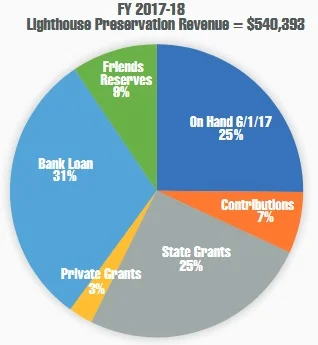
FY 2017-18 Lighthouse Preservation Revenue Highlights
As the chart at right shows putting together the cash flow puzzle to keep this project on-track required balancing a number of factors. The 3 major puzzle pieces were cash-on-hand from prior year grant payouts and fundraising, a state of Florida historic preservation grant, and a loan from Centennial Bank. The Friends want to thank Will Davis, Chief Lending Officer at Centennial, and his team for their extraordinary efforts to help make this loan possible. Being approached for a large loan by a small non-profit with few assets, no loan track record, and no collateral required a special commitment to the project by Centennial to make this happen.

FY 2017-18 Lighthouse Preservation Expense Highlights
While putting together the revenue streams to fund the Lighthouse was complicated, the expenses were very straightforward. Expenses were almost entirely for our general contractor, Rippee Construction. Working within budget constraints, historic preservation regulations, and up against state grant time deadlines, Carol Rippee and her company amazed everyone with historically accurate and beautiful work restoring the Lighthouse to its historic grandeur.

FY 2017-18 Friends Programs & Operations Revenue Highlights
This is the more typical picture of Friends revenue that goes to fund our ongoing support of Refuge projects: Visitor Services, Conservation, Environmental Education, and the Monarch/Milkweed Initiative. As has been true for a number of years, the largest revenue source is profits from the Nature Store followed closely by contributions in the form of memberships and other donations. Nature Store profits reached a new record of $58,750 in FY 2017-18. Combined membership and contribution revenue totaled over $46,500 another new high in support for the work of the Friends.

FY 2017-18 Friends Programs & Operations Expense Highlights
As shown in the chart at right, most Friends dollars are spent for program support and interns. Each year Refuge staff submit budget requests for review, first by Refuge management and then the Friends board. The Friends board holds an annual budget meeting to review Refuge priorities and make funding allocations to the programs based on anticipated revenues. The largest Friends administrative cost is for CPA assistance with financial and IRS reporting. This provides donors, grant makers, and, in the past year, lenders to the Lighthouse project assurance that Friends funds are managed and reported in compliance Generally Accepted Accounting Principles or GAAP to insure consistency in our financial statements which are available to the public.
Board Committees
The real work of the Board happens in our Standing Committees which include Board Members and other members of Friends who volunteer to serve in some capacity. The committees listed below are active and would welcome your involvement.
Membership
Recruits and maintains active Friends members, maintains membership database, organizes member invitation-only events, organizes service opportunities for members.
Fundraising

Develops and implements a plan to raise funds to accomplish the Friends mission of support to the Refuge. Performs annual and long-term fundraising to support refuge projects, solicit major gifts and encourage planned giving. (Examples of Friends’ fundraising are the access ramp at right and kayaks purchased for the Refuge Junior Rangers, below right.)
Communications
Promotes Refuge and Friends activities, projects and events to members and the general public via monthly email newsletters, website, social media, traditional media and this Annual Report.
Lighthouse

Works in partnership with the USFWS to plan and fund efforts to preserve the lighthouse and create a compelling visitor experience.
Nature Store
Sets policy for the store and advises and assists the store manager in all aspects of the store operation including selection and purchase, sales, and inventory of merchandise.
Volunteers – The Secret to Success
“Volunteering is the ultimate experience in democracy. You vote in elections once a year, but when you volunteer, you vote every day about the kind of community you want to live in.” (Anonymous)
The fact that you are reading this newsletter indicates that you appreciate the Refuge: whether it’s viewing wildlife; photographing and painting scenery and birds; hiking; launching your kayak or fishing boat; visiting the lighthouse; or any other of the myriad reasons that we visit. Maybe you just want some good revitalizing time away from your work or busy lifestyle.
I first started volunteering at the refuge about 25 years ago working in the Visitor Center on weekends. I had been visiting the refuge for many years enjoying its beauty and occasionally counting on its serenity to regain my senses during rough times. I wanted to give something back to this incredible place. Being a nurse, I was uncertain that I had any skills that were needed. Well, how wrong I was! I found that greeting and helping people in the Visitor Center was immensely rewarding and educational. Many wonderful years later look where I am now
Research shows that there are 5 Reasons why you should consider volunteering.
- Volunteers live longer and are healthier
- Volunteering establishes strong relationships
- Volunteering is good for your career
- Volunteering is good for society
- Volunteering gives you a sense of purpose
Although it is not well-understood why volunteering provides such a profound health benefit, a key factor is assumed to be that volunteering serves to express and facilitate opportunities to carry out one’s sense of purpose. (Psychology Today, March 2014.)
There is something incredibly satisfying in helping to support the Refuge’s diverse environment and its history. Working with the Friends group is working with like-minded people who want to give back to the refuge.
Would you like to give something back to the place that provides so much joy for you?
The Friends group can always suggest volunteer opportunities that will help us fulfill our mission. We would not be able to continue doing our work without people joining the effort.
Perhaps you are interested in planning activities or working with fundraising or bookkeeping. Maybe you are only able to work inside at the Visitor Center. There are plenty of things to do. Every project that I have worked on has given me great joy and satisfaction. That includes pulling invasive weeds to putting on ice cream socials. Sometimes it is tiring but it is all rewarding.
Everyone has expertise to offer, and we would love to have you volunteer with us, work with us, and help us.