
Annual Report – FY 2018-2019

Annual Meeting
The Friends of St. Marks Wildlife Refuge met for the 2019 Annual Meeting on Saturday, April 27, in the Visitor Center Education Building.
The presentations included very positive, concise information related to our finances, as well as Refuge updates on current programs and challenges that gave the large audience a realistic look back at the past year and excitement over the coming one.
Long-time Board of Directors Secretary, Melissa Jacoby, completed her six-year volunteer tenure, and she was recognized for her dedicated service. In addition, departing board members, Sue Conte (Board VP) and Carol Phillips were singled out for their important service to the Refuge and the Board over the recent years.
Also, several new board members were introduced: Bill Clutter, Bill Everitt, and Karen Cummins. With Melissa Jacoby and Sue Conte leaving, the structure of the Executive Board is now as follows: Susan Cason, President; Phillip Pollock, VP; John Haines, Treasurer; and Karen Willes, Secretary.
Those attending the Annual Meeting had the added luxury of hearing a really great presentation from local, nationally-recognized author, Jeff VanderMeer. Jeff has been a prominent Refuge supporter, and his best-selling Southern Reach Trilogy (and the setting in his novel, known as Area X) was inspired by his frequent visits to the Refuge. Again, we extend a huge thank you to Jeff for all of his contributions to the Refuge.
President’s Message
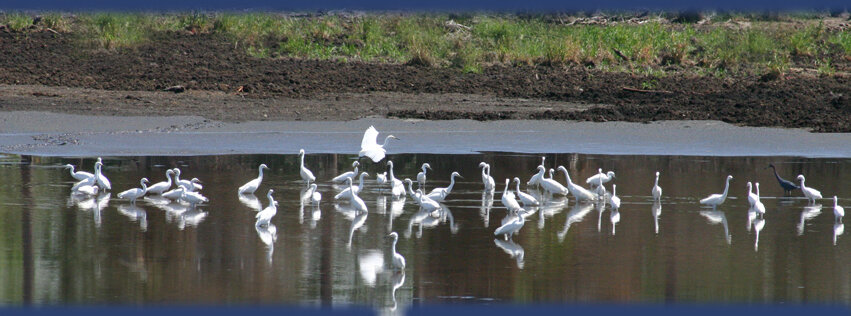
How very fortunate we are to have the St Marks National Wildlife Refuge. There is nothing as grand as the salt marsh and the stately pines and palms that talk to us about old Florida. It helps me to keep these pleasant images in my subconscious as I reflect on the past year. We’ve seen some very good things happen at the Refuge over the previous year, and we’ve had some difficult issues to address, as well.
The government shutdown last winter affected our Refuge staff for over a month; their income and serenity suffered. To show our support for them, the Friends provided Refuge staff with a picnic lunch from Sonny’s BBQ on a very chilly mid-winter day. The refuge staff not only enjoyed the food, but they appreciated the opportunity to get together with their co-workers and Friends again.
The lighthouse relighting event in October was a tremendous success. It was very impressive to see the lighthouse come to light and see the keeper’s quarters restored with great integrity and attention to historical detail. The evening resonated with excitement that was shared by many local participants. The relighting culminates a 5-year effort by the Friends to realize this accomplishment.
We held a very successful Friend-building event with Proof Brewing the day before the official lighthouse event at the Refuge. We are grateful to the hundreds of people who showed up to support the lighthouse by purchasing the specially crafted beer in commemorative glasses that sold out in 20 minutes. We are looking forward to repeating this event in the coming year to support the intern programs.
The Friends have also put some wonderful improvements in place this year. One of them is a beautiful new website, filled with a lot of important, new information. If you’re reading this report, you are in the site right now. Take a few minutes to navigate some of the links that lead to information-packed pages.
Behind-the-scenes, we implemented a quicker checkout process in the Nature Store. In addition, the store inventory is now talking to our book keeping system; when technology is working, it’s a joyful time. This means more accountability and productivity for you, the Friends’ members.
Behind-the-scenes, we implemented a state-of-the-art iPad-based POS (point of sale) system in the Nature Store. By harnessing technology we have simplified the sales process and taken the struggle out of inventory management. Now our Nature Store manager has up to the minute data to use in ordering and product selection to maximize sales and profits. When technology is working, it’s a joyful time. This means more accountability and productivity for you, the Friends’ members.
The Refuge exists and thrives because of you. Your donations, membership, and purchases at the Nature Store make it happen. Thank you for making this past year a very progressive one.
Lighthouse Restoration Culminates with Re-Lighting
This has been a momentous year in the restoration of the lighthouse.
The keeper’s quarters are now open on a scheduled basis, and visitors can tour the restored facility and learn from and enjoy the exhibits that are in place. New exhibits are rotated so that the experience is never static. The Friends acquired a grant from the Florida Lighthouse Association for exhibits and professional signage for the displays. Additionally, at the urging of the Friends, a concept plan for interpretation and public use was developed by Lee and Marvin Cook of Caribbean Heritage Concepts to guide future development of the lighthouse experience.
On May 17, the Florida Trust for Historic Preservation presented the Friends the award for Meritorious Achievement in Restoration /Rehabilitation for the four-year St. Marks Lighthouse Restoration project. The award recipients also included the St. Marks National Wildlife Refuge, Kenneth Smith Architects, and Rippee Construction. Thanks to all who contributed and worked so hard to realize the restoration of the lighthouse.
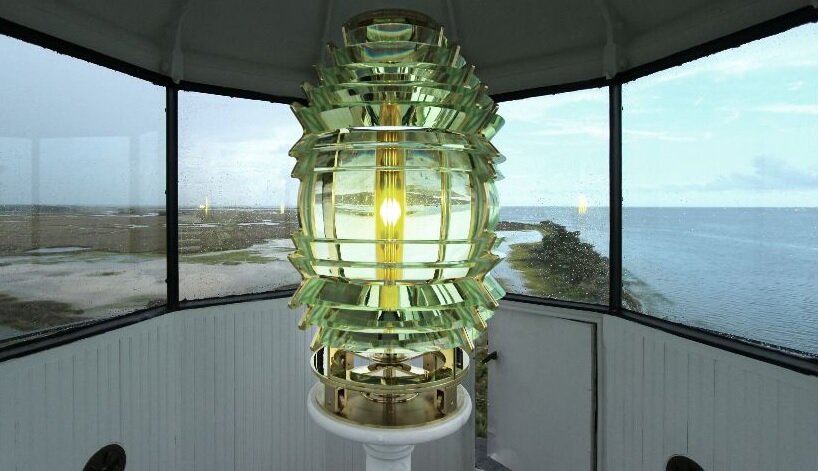
Most significantly, thanks to numerous donations, a replica of the historic Fourth Order Fresnel Lens was constructed by Artworks Florida and installed in the restored lantern room on July 12. The official lens re-lighting ceremony took place October 31, 2019 at the lighthouse. A huge crowd of visitors and friends came to witness this important history unfold.

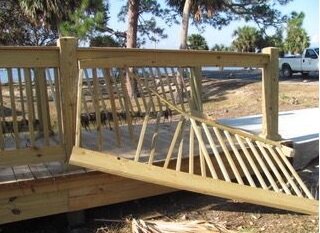
The new accessibility ramp was also completed in 2018, with landscaping allowing everyone access to the keeper’s quarters. The ramp is an extremely important access feature at the lighthouse, allowing people with disabilities to also enjoy the historic lighthouse.
There is more to do to fully restore the historic light station.Next, as funds are available, we will replace the gutters, reconstruct the shutters on the rear windows, and reconstruct the white perimeter picket fence, which once defined the light station. Fundraising will continue in the coming years to fully restore historic segments of the light station. We hope everyone will visit the lighthouse regularly and stay invested in helping us “Bring the Past to Light.”
Smith’s Island – Environmental Paradise
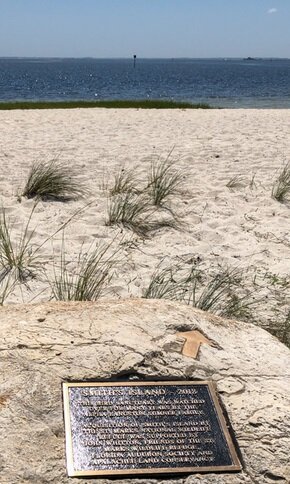
It took over two years of negotiation and a lot of legal wrangling to allow the Refuge to acquire Smith’s Island. A lot has been said about this important acquisition over the past year or more in the Reflections newsletter, and that is as it should be, because it is an extremely important Refuge acquisition that Friends have facilitated. Smith’s Island is one of the last major rookeries in the northern Gulf of Mexico.
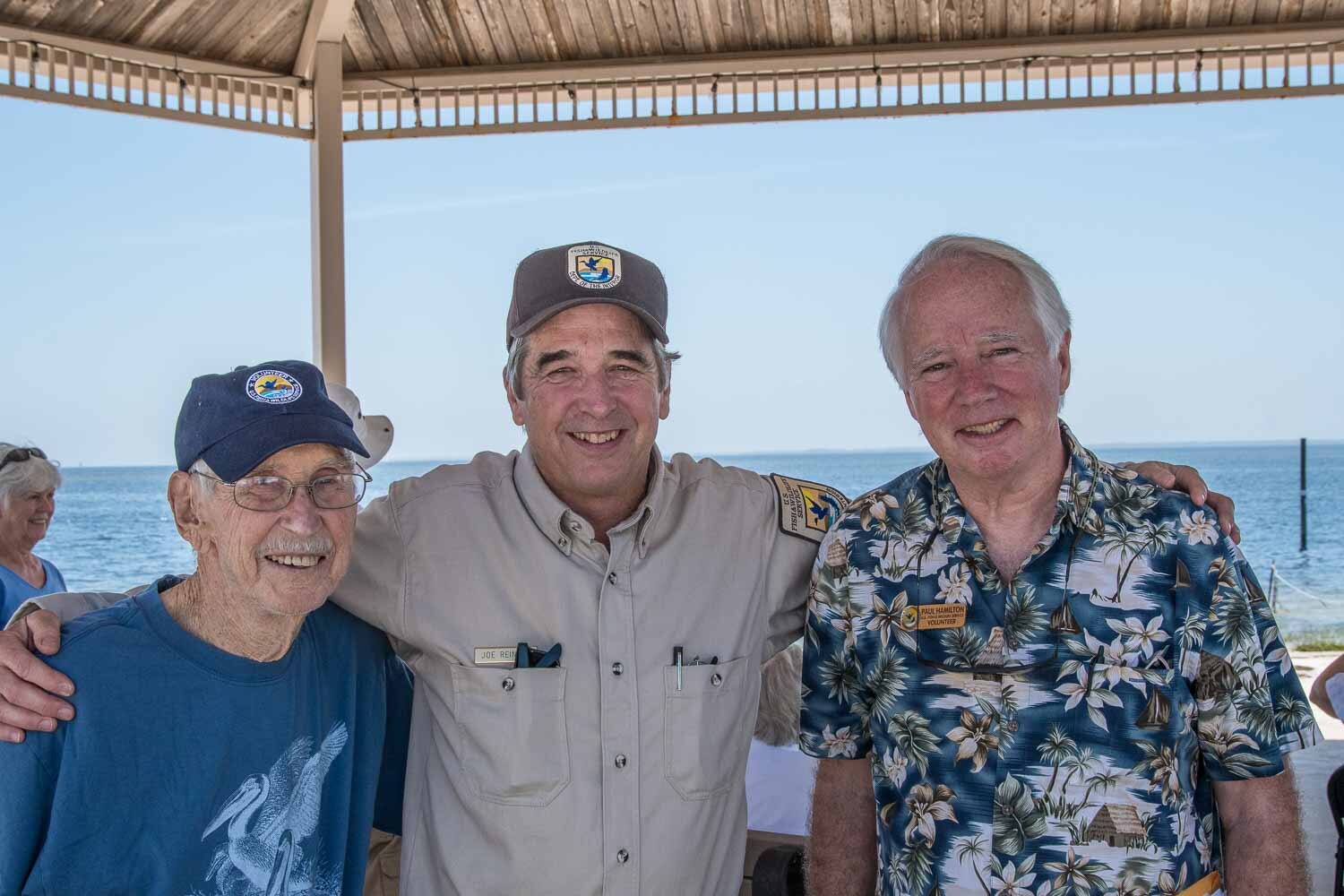
The Smith’s Island dedication took place at Shell Point on April 29. It was a significant day for Friends of St. Marks Wildlife Refuge. An enthusiastic crowd attended for this important final step in the acquisition and protection of Smith’s Island. Key attendees at the event were (left to right) John Whitton, Joe Reinman, and Paul Hamilton. Many thanks are extended to these individuals for the strong role they have played in bringing Smith’s Island to the Refuge.
Monarch / Milkweed Initiative
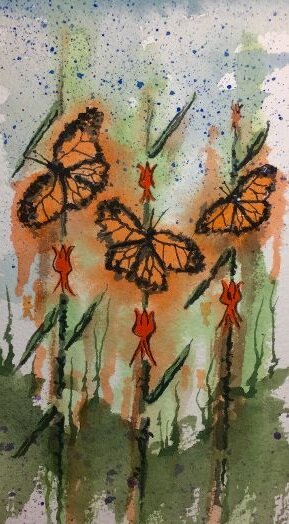
The Friends group prides itself in supporting the Monarch / Milkweed Initiative. As the monarch butterfly population continues to decline across North and South America, the Initiative’s efforts have focused on discovering the root-causes of this decline. Providing an active source of the monarchs’ host plant, milkweed, is an important goal in the initiative. Certainly, the St. Marks National Wildlife Refuge geographic position along the migratory flyway of monarchs is important and serves as an ideal setting for the plants and the research.
Through the support of the Friends, the Initiative has allowed funding multiple interns and the construction of a milkweed nursery for the research and propagation of milkweed plants. The Initiative has also allowed us to successfully research every species of milkweed found inside of the Refuge.
Again this past year, activity in the Monarch / Milkweed Initiative revolved around many volunteers giving great numbers of hours of service to make this effort the success that it is today. The Wednesday morning workdays, typically, attract 4-10 workers who all help Refuge staff in making the initiative recognized nationally.
This past year, thousands of plant cells have been sown to help further the milkweed populations. The plant species include amplexicaulis, humistrata, tomemtosa, incarnata, viridiflora, pedicillata, matalea, and 2 subspecies of tuberosa.
Also in the past year, a number of groups visited the nursery, partly due to recognition that has grown for the Monarch / Milkweed effort. FSU sustainability department, Chattahoochee Nature Center (Georgia) and the Institute of Food and Agricultural Science in Okaloosa County are just a few of the organizations who have visited. Duke Energy also visited over the late spring to get information about plantings they could put in place along power line easements.
One specific example of current research notes that wild populations of A. humistrata, found directly in-and-around the Refuge, make it advantageous to study the milkweed life cycle. Resulting data collected helps to determine when plants come up, when they flower, what insects are pollinating them, and when they yield seeds, which is useful information for workers in the nursery.
The Monarch / Milkweed initiative is important. The Friends have been excited to see how this effort has evolved over time, and that it is now a biological initiative that it is being recognized nationally.
The Carney Interns Make a Difference
Thanks to important support by Dr. Ed Carney, four wildlife conservation interns now come to the Refuge each year to carry on important conservation work under the guidance of Refuge biologists.

The Carney Interns helped establish and now monitor Red-Cockaded Woodpeckers (RCW). Their work helps Refuge biologists determine how successful recent translocation projects have been and where translocated RCWs are nesting within the Refuge. The Carney Interns monitor the progress of the active clusters. They also work toward site restoration that is critical to RCW translocation by removal of habitat invasives such as cogon grass, torpedo grass, and Cuban bulrush.
These dedicated and enthusiastic students have also been the driving force behind the successful efforts to rebuild populations of the threatened Frosted Flatwoods Salamanders. The interns have helped to establish a nursery for the salamander larvae so that greater numbers of the federally threatened species could be returned to their natal ponds. This past year was difficult due to Hurricane Michael, reducing salamander numbers. This past year, most of the salamander drift fences had rusted out from saltwater intrusion due to Hurricane Michael and they had to be removed. New fences are now being treated with a sealant to prevent rust and installation has been on-going. Salamander numbers rapidly increased as the year advanced.
Nature Store
FY 2018-19 brought a mix of good news and bad. A win for the Nature Store was the introduction of four new products. Each involved the generous participation of some very talented folks: a writer, a wood craftsman, local photographers, and a birder.
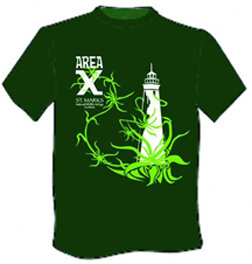
Area X shirts were introduced in September 2018. The design is based on author Jeff VanderMeer’s book Annihilation. The setting is a pristine wilderness area that Jeff acknowledges was inspired by his hikes in the Refuge. By May 31, the end of our fiscal year, over 350 shirts were sold and shipped worldwide.
Chip Coffin, a Friends’ member, started making walking sticks and donating them to the store in November 2018. The handles are beautifully wrapped with bead work and often exhibit a little carving. We easily sell all the sticks he brings us.
In November 2018, we started selling photo cards depicting Refuge wildlife and landscapes. The images are donated by local photographers and by the end of the fiscal year, over 550 of these beautiful cards had been sold.
In April 2018, our favorite birder, Don Morrow, created and donated the Checklist of the Birds of St. Marks NWR.This small, but very detailed, booklet, which we produce in house, became an instant hit with the many bird enthusiasts who visit the Nature Store.
Finally, we can’t talk about good news without mentioning the American Flamingo arrived with Hurricane Michael and stayed on for 8 months. (He has since been seen intermittently) This beautiful bird caused quite a commotion in the bird world and brought folks from hundreds of miles away to the Refuge—many of whom stopped and shopped. Thanks, Pinky!
The bad news was two-fold: in October 2018, Hurricane Michael caused a 10-day closing to allow for cleanup and repairs. The second hit came with the 35-day government shutdown in January. Though the gates were open and the flamingo was here to be seen, the Visitors Center was closed. In spite of these two shutdowns, we were still able to respond to email requests for Area X shirts. Using PayPal, we sold over 70 Area X shirts during those closures.
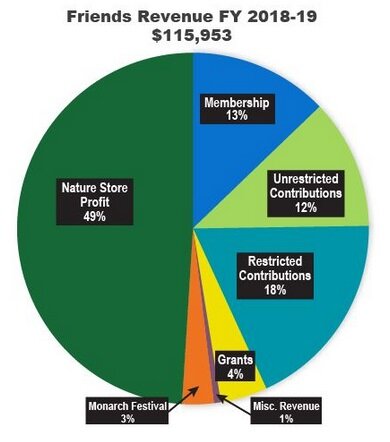
All told, another successful year as the Nature Store continues to be the number one source of Friends’ income that supports the Refuge mission. Considering the 45 days lost to unplanned closings, that the Nature Store finished the year just $1900 under last year, is good news indeed.
Financial Report
Hurricanes and Shutdowns Impact Spending but Not Revenue
While the Refuge was closed for “just” 45 days due to Hurricane Michael and the prolonged government shutdown, the disruption to normal Refuge operations of both those events extended over a much longer period. Refuge staff usually involved in conservation, education, or public use activities found their time taken up by cleaning up, preparing for shutting down, and getting back on track to resume operations. It turns out that you can’t just flip a switch and turn a complex operation like the Refuge off and on. The planning and preparation on both ends require a lot of time and effort.
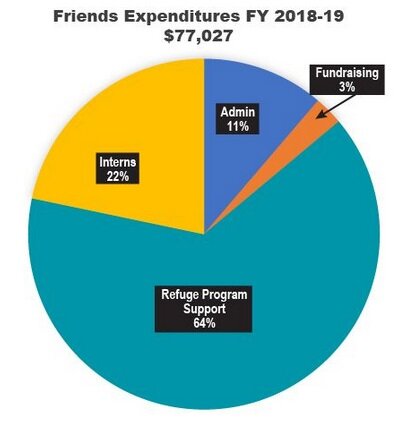
For the Friends finances this meant a significant reduction in expenditures from past years due to the reduced time Refuge staff had to work on the projects funded from Friends contributions. Overall revenue was not much effected with memberships and donations holding steady while Nature Store profits were near last year’s record – even with 45 fewer days of operation.
The end result of steady revenue and decreased expense was a large budget surplus ($38,000) to begin FY 2019-20. The board used this surplus to create a $30,000 Leadership Priority program which will be used by Refuge Manager, Terry Peacock and North Florida Refuge Complex Project Leader, Dan Frisk for unfunded Refuge priorities in the next fiscal year.
Annual Meeting
The Friends of St. Marks Wildlife Refuge met for the 2019 Annual Meeting on Saturday, April 27, in the Visitor Center Education Building.
The presentations included very positive, concise information related to our finances, as well as Refuge updates on current programs and challenges that gave the large audience a realistic look back at the past year and excitement over the coming one.
Long-time Board of Directors Secretary, Melissa Jacoby, completed her six-year volunteer tenure, and she was recognized for her dedicated service. In addition, departing board members, Sue Conte (Board VP) and Carol Phillips were singled out for their important service to the Refuge and the Board over the recent years.
Also, several new board members were introduced: Bill Clutter, Bill Everitt, and Karen Cummins. With Melissa Jacoby and Sue Conte leaving, the structure of the Executive Board is now as follows: Susan Cason, President; Phillip Pollock, VP; John Haines, Treasurer; and Karen Willes, Secretary.
Those attending the Annual Meeting had the added luxury of hearing a really great presentation from local, nationally-recognized author, Jeff VanderMeer (right). Jeff has been a prominent Refuge supporter, and his best-selling Southern Reach Trilogy (and the setting in his novel, known as Area X) was inspired by his frequent visits to the Refuge. Again, we extend a huge thank you to Jeff for all of his contributions to the Refuge.
Setbacks and Successes – Hurricane Michael and the Shutdown Hit Hard
In the past year, two events affected Friends’ finances: : Hurricane Michael and the government shutdown.
In retrospect, as severe as the Hurricane was, the physical damage to buildings and roadways was not as pronounced as we thought it might be. Yes, there was damage, but it could have been far worse. Probably of greater significance was the environmental impact of habitat loss and diminished animal populations. The latter environmental concerns are hard to measure, but given the strength of the storm, we know there had to be a negative impact.
The government shutdown in January, was not a weather event, but a political/governmental one, and it did pose a significant challenge for the Friends and for the Refuge. To understand this, we only need to look at the closure of the Nature Store during the shutdown, because the store is the Friends’ major source of income throughout the year. During the approximate month of closure, the loss of income from the Nature Store was nearly $15,000 that would typically be used to support Refuge projects. In addition, the closure interfered with Refuge and Friends’ event and activity programs that often result in added income due to gate fees and attracting new members. For example, the February Wildlife Heritage and Outdoor Festival had to be canceled. That’s an event where Friends expect to see lots of community awareness and a time for attracting new members.
Fortunately, the anticipated financial hit was eased by rebounding sales in the Spring of 2019 and lower than expected expenses. The one-two punch of Michael and the shutdown showed the Friends’ board the necessity of adequate financial reserves to meet unexpected circumstances
Both the hurricane and the shutdown did have a rosier side, however. Where the hurricane was concerned, the physical damage was restricted, in part, to the accessibility ramp leading to the lighthouse. The ramp had just recently been built to assist the disability communities. And, though the roadways were more significantly impacted, the damage to buildings and the lighthouse could have been far worse.
The amazing aspect of the shutdown was the way our volunteers reacted to the closure and the resulting Nature Store closure. The store was still able to follow-up on the sale (through electronic communications) of the Area-X t-shirts, and that generated the only income for the store and the Friends during the shutdown. We are fortunate to have dedicated volunteers who made that happen.